
New Glenn Explodes on Launch Pad
A significant setback for Blue Origin, NASA's aggressive lunar program and Amazon's Leo constellation

A Blue Origin New Glenn rocket exploded on the launch pad at Cape Canaveral in Florida on Thursday evening during a static fire of the booster’s first-stage engines. The rocket was being prepared to launch 48 satellites for Amazon’s Leo broadband constellation next week.
“All personnel are accounted for and safe. It’s too early to know the root cause but we’re already working to find it. Very rough day, but we’ll rebuild whatever needs rebuilding and get back to flying. It’s worth it,” Blue Origin Founder Jeff Bezos posted on social media.
It appeared that the explosion caused significant damage to the launch pad at Cape Canaveral Space Force Station. The extent of the damage and how long it will take to repair is unknown.
The explosion occurred six days after the Federal Aviation Administration (FAA) gave the company approval to resume launches following the failure of a New Glenn rocket on April 19. The booster placed AST SpaceMobile’s BlueBird 7 in a useless orbit due to the under performance of one of the two BE-3 second-stage engines. AST SpaceMobile declared the satellite a complete loss and deorbited it.
On Tuesday, NASA announced that Blue Origin would play a leading role in its Artemis lunar program. A New Glenn rocket was scheduled to send Blue Origin’s Blue Moon Mark 1 Endurance lander with NASA payloads to the lunar south pole no earlier than Fall 2026. That launch will likely be delayed.
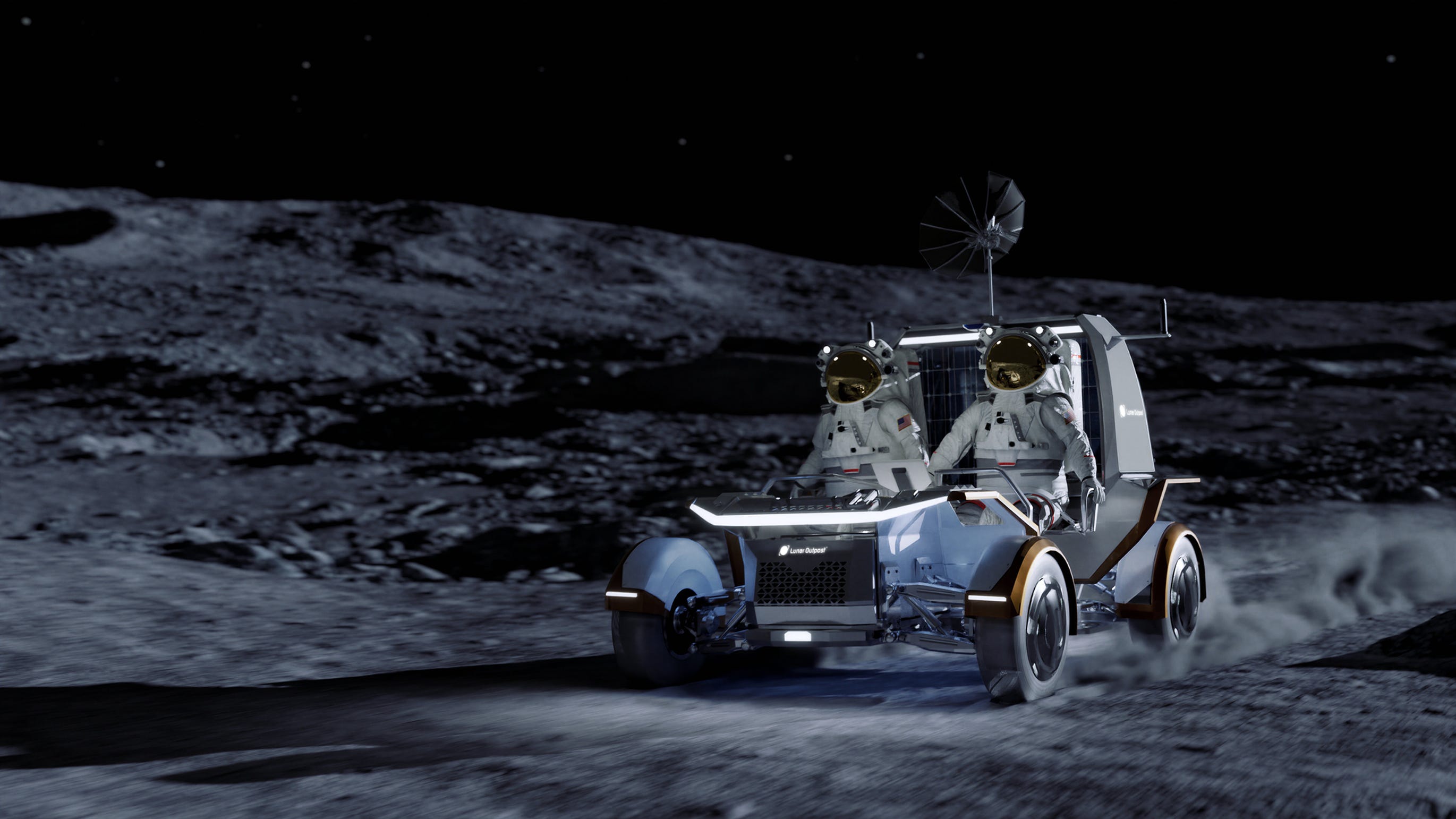
NASA also announced this week that Blue Moon landers would deliver to lunar terrain vehicles for future Moon crews in 2028. The LTVs are being developed by Venturi Astrolab and Lunar Outpost.
NASA’s Artemis III mission, which is set for mid-2027, aims to have an Orion spacecraft dock with Blue Origin’s Blue Moon lander and SpaceX’s Starship lunar lander in Earth orbit. NASA is planning to land two astronauts on the Moon using one of the landers during the Artemis IV mission in 2028.
The loss of New Glenn is also a setback for Amazon’s Leo constellation, which has experienced significant delays in deployment. Amazon was originally required to launch half of the 3,236-satellite constellation by late July 30, 2026, with the remainder by July 30, 2029. To date, the company has only launched 302 production satellites. Amazon has applied for an extension from the Federal Communications Commission.
The explosion also could be bad news for United Launch Alliance (ULA). Blue Origin uses liquid methane/liquid oxygen BE-4 engines on the first stage of New Glenn. The company supplies the same BE-4 engines for ULA’s Vulcan Centaur rocket. Vulcan Centaur has experienced delays due to unrelated problems with strap-on solid-fuel rockets attached to the first stage.
New Glenn was successful in its first two flights in 2025. Blue Origin landed a New Glenn first stage on an offshore ship on the rocket’s second launch. That stage was successfully reused on the third flight.
On Sept. 1, 2026, a Falcon 9 rocket exploded on the launch pad as it was being prepared for a static fire. The Amos 6 satellite was lost in the explosion.
This is a developing story. More details will be posted as they become available.